
Where to go: menu Operations → Pricing & Freight → Interprovincial Delivery (/transport/pricing/intercity-delivery) → Add. Read the general section first if you haven't grasped the scope/priority rules.
1. The system supports 7 calculation methods — choose according to your business model
The table below summarizes all available freight calculation methods to help you select the right approach for your operations.
| # | Calculation Method | Suitable For | Quick Example |
|---|---|---|---|
| 1 | Fixed Price | Flat-rate carriers: "one package 30k regardless of weight" | 30,000đ per package |
| 2 | By KG | Linear unit price by weight | 5,000đ/kg → 8kg = 40,000đ |
| 3 | By Item/Package | Calculated by number of packages, weight doesn't matter | 20,000đ × 3 packages = 60,000đ |
| 4 | By Cubic Meter | Large volume goods: furniture, materials | 800,000đ/m³ × 0.5m³ = 400,000đ |
| 5 | KG Tiered | Most common in courier industry | See section 3 |
| 6 | Item/Package Tiered | More packages = cheaper unit price | 1–5 packages: 25k/package; 6+: 18k/package |
| 7 | Cubic Meter Tiered | Volume goods, price by volume level | 0–1m³: 500k; over 1m³: 400k/m³ |
2. Portal declaration interface
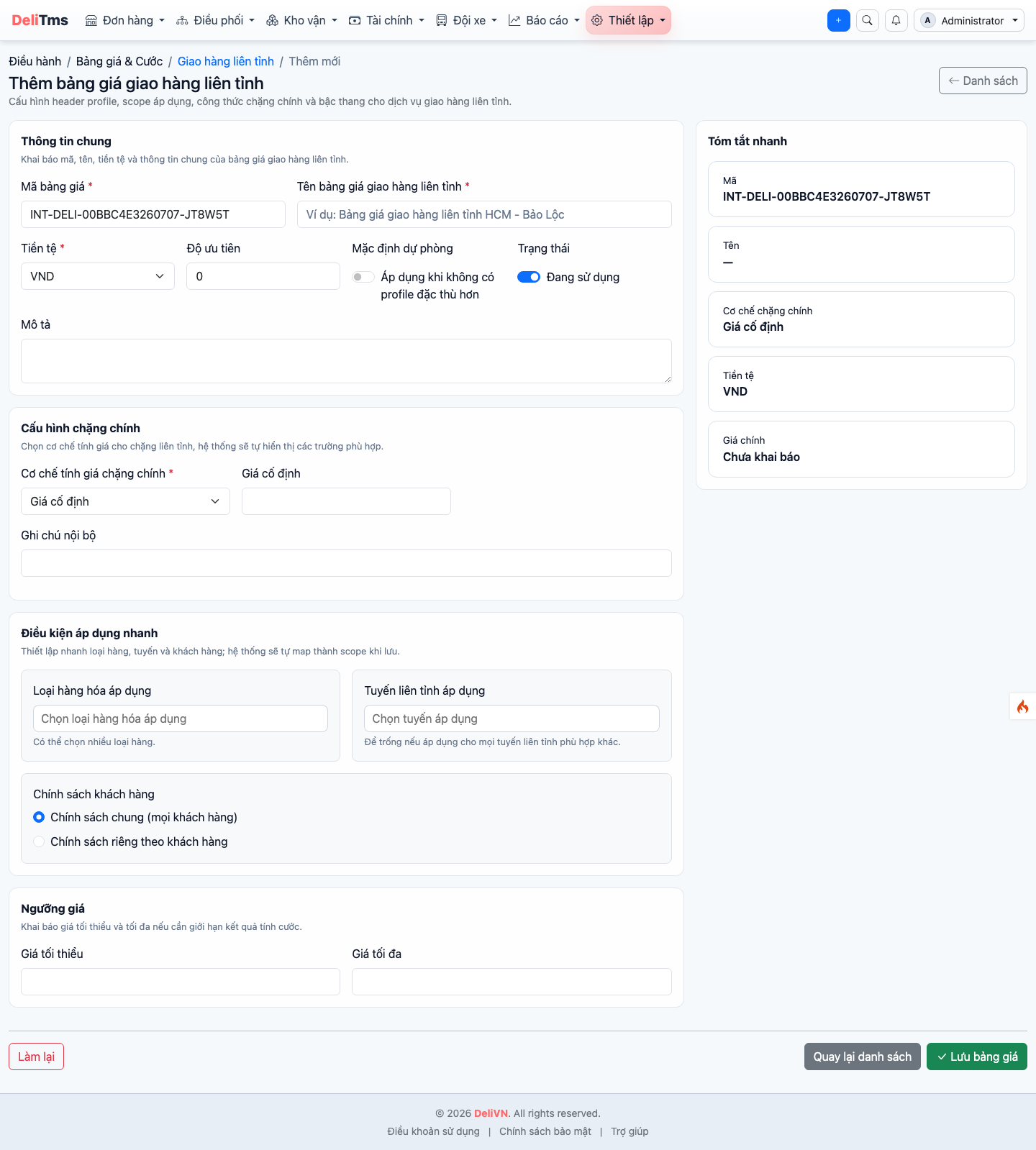
"Add Interprovincial Delivery Pricing" form on portal — General Information, Main Leg Mechanism, Quick Application Conditions, Price Thresholds.
3. Billable unit & bulky goods — factors directly affecting revenue
With KG calculation method, the system asks: which weight to use for calculation? The billable weight can be determined using one of these options:
- Actual Weight — by weight only. Dense goods, not bulky.
- Volumetric Weight — length × width × height (cm) ÷ factor (default 5000).
- Greater of the two — recommended: preserves revenue in both dimensions.
Rounding: up to 0.5 / 1 / 5 kg — for example, choosing "up to 0.5kg" means 3.2kg becomes 3.5kg. Minimum / Maximum charge: caps both ends AFTER calculation — always set a minimum charge.
Practice below: enter a pillow box 60×50×50cm but only weighs 2kg, then switch "Billable Unit" between Actual Weight and Greater of 2 — observe the freight change to see the importance of this choice.
4. Tiered pricing — the most important content to master
4.1 Tier structure
Each tier has From – To. Tiers must be continuous, no gaps, no overlap: 0–3, 3–5, 5–10, 10–(empty). The last tier leaves "To" empty = unlimited. On the portal there's a "Create by cargo weight group" button that generates the company's tier framework.
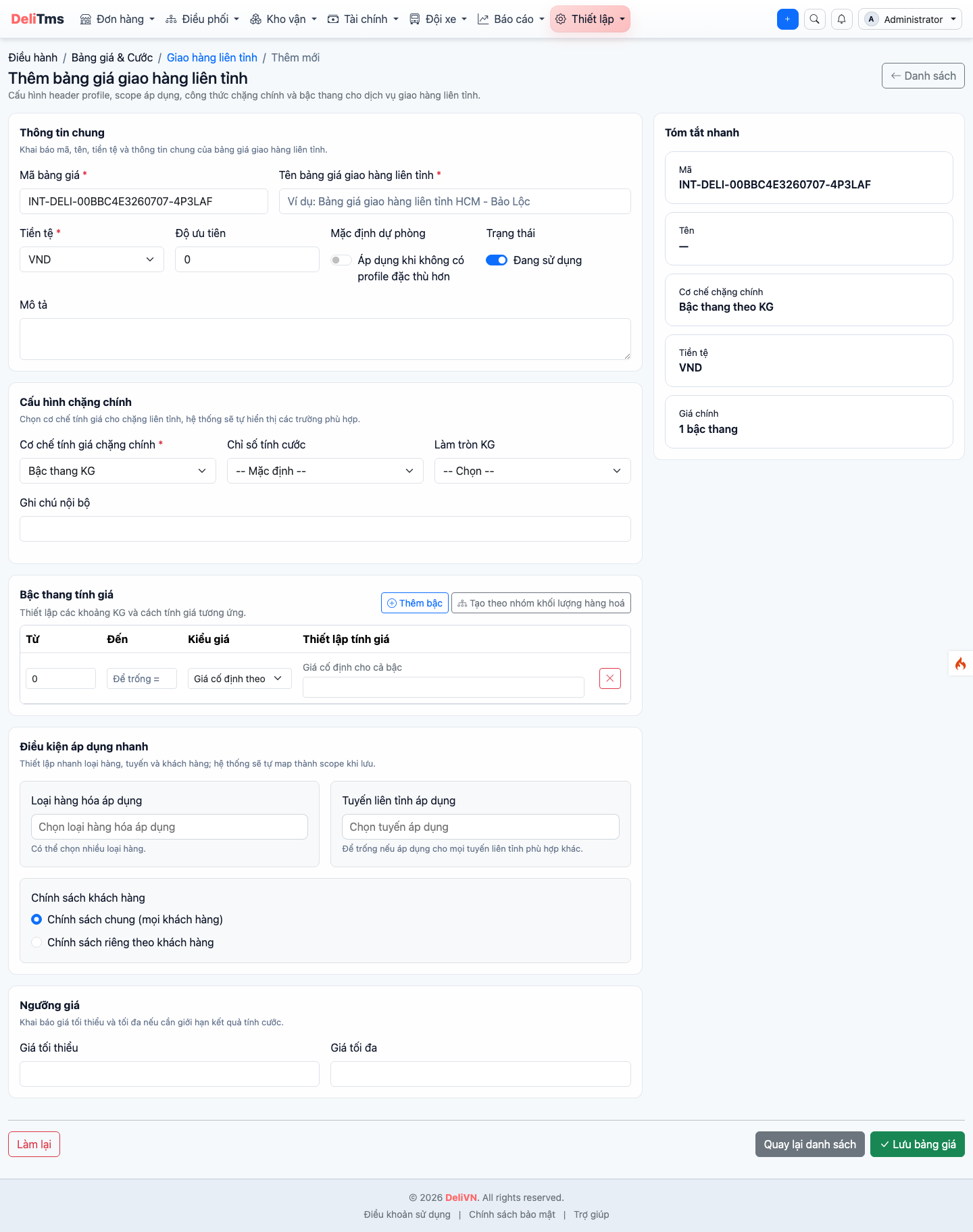
Form when selecting "KG Tiered" mechanism — From/To tier table with 3 price types, matching the TEST CALCULATOR below.
4.2 Three price types within a tier
| Type | Calculation | Example | Use When |
|---|---|---|---|
| Fixed | Falls in tier = ONE flat rate | Tier 0–3kg price 25,000đ ⇒ order 0.5kg or 2.9kg both 25,000đ | Easy for customers to remember ("under 3kg flat rate") |
| Unit Price | ENTIRE weight × tier's unit price | Tier 5–10kg, 6,000đ/kg ⇒ 8kg order = 8 × 6,000 = 48,000đ (multiply entire 8kg) | Price proportional to weight within each range |
| Base + Increment | Base fee + portion EXCEEDING "From" threshold calculated by steps (rounded up to full steps) | Over 10kg: 60,000 + 4,000/kg excess ⇒ 14kg = 60,000 + 4×4,000 = 76,000đ; 10.3kg = 60,000 + 1 step = 64,000đ | Heavy goods "opening price + excess" — method used by major carriers |
4.3 Complete tiered pricing table — select each sample order for comparison
The frame below is pre-configured with exactly the 4-tier table in the documentation (0–3 fixed 25k · 3–5 fixed 35k · 5–10 unit price 6k/kg · over 10 base 60k + 4k/kg excess; unit "greater of 2", factor 5000, round up to 0.5kg). Select in sequence 5 sample orders — results must be correct: 25,000 · 35,000 · 48,000 · 76,000 · 140,000đ. You can then adjust tiers/prices according to your business policy and cross-check again.
The "pillow box" line showing 140,000đ is exactly why you must choose the correct billable unit: if changed to "Actual Weight", it would only be charged 25,000đ — causing loss of freight revenue.
4.4 ITEM tiered and M³ tiered — same principle
Change "Calculation Method" in the frame above to Item Tiered or M³ Tiered to try: "From–To" then becomes number of items / number of m³. Item example: 1–5 items unit price 25,000đ/item, over 5 items 18,000đ/item → 8 items order = 8 × 18,000 = 144,000đ (unit price type multiplies entire amount).
5. Walkthrough: create default pricing table in 5 minutes
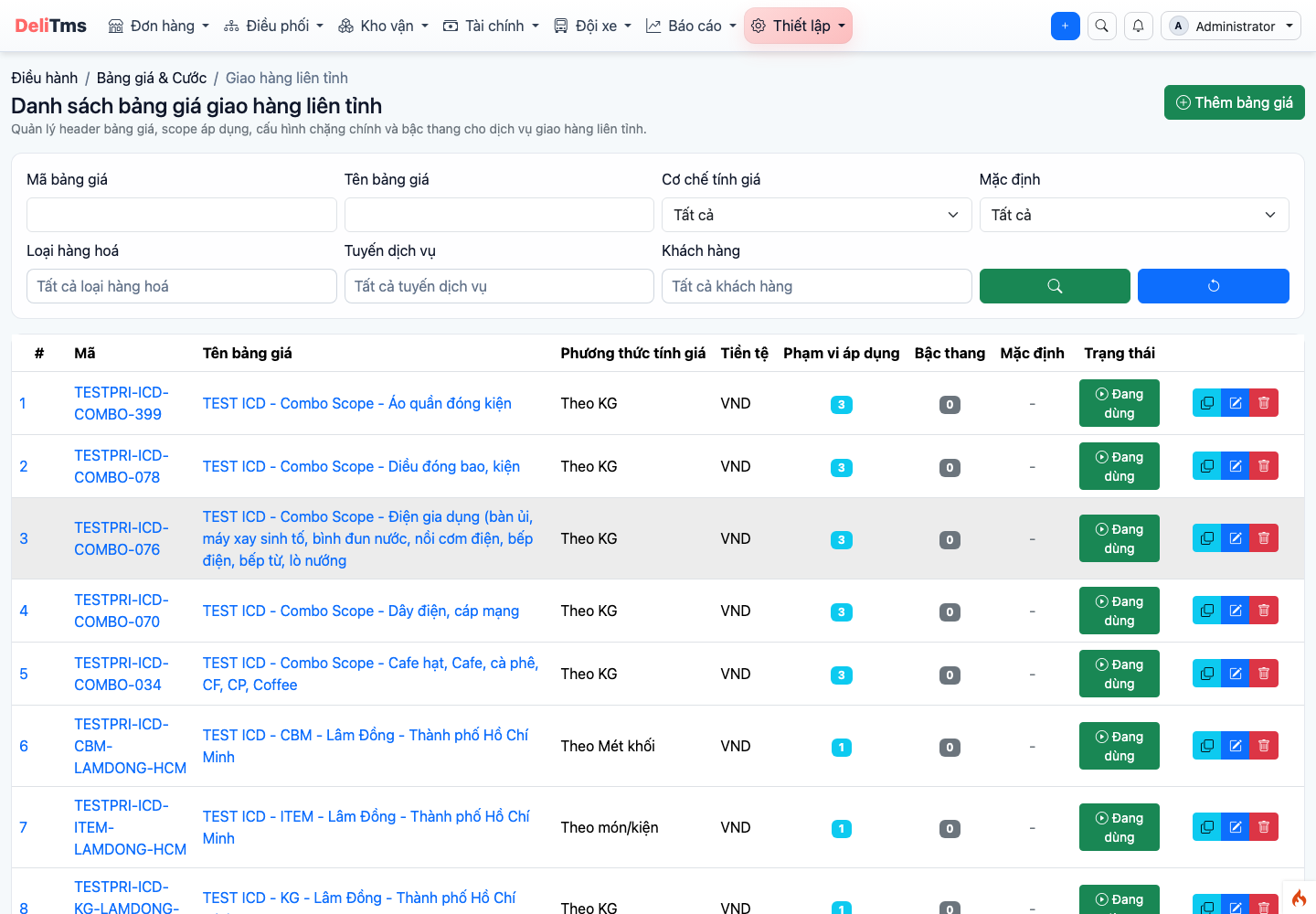
Interprovincial pricing list — each table has Copy / Edit / Change Status. You can review your TMS pricing table configuration here.
- Go to
/transport/pricing/intercity-delivery→ Add. - Code
LT_MAC_DINH, name "Default Interprovincial Pricing". - Calculation method: KG Tiered · Billable unit: Greater of actual weight and volumetric weight · Rounding: up to 0.5kg.
- Select "Create by cargo weight group" → fill in prices for 4 tiers as in section 4.3.
- Minimum charge 20,000. Application conditions leave all blank. Check Default + Activate → Save.
- Verification: create 5 test orders like the 5 sample orders in section 4.3 — freight on form must match numbers in TEST CALCULATOR frame.
6. After default table: separate prices by route / customer / cargo type
- One price per route: Copy default table → edit price → scope assign Route → save. Orders on other routes still fall back to default.
- Contract customer: separate table assign Customer — system ALWAYS prioritizes tables with customer assigned.
- Separate cargo type (refrigerated, chemicals): table assign Cargo Type; can combine with route/customer in same table (order must match all declared scopes).
Not clear which table will "win" when multiple tables match? Return to the test frame in general section — scope & priority section.
Special cargo without standard pricing (machinery, oversize/overweight): DeliTMS does not yet have mechanism for staff to manually enter freight per order — handle with separate pricing table assigned to cargo type "Special" with negotiated unit price.